"Should we get a chatbot or a voice agent?" We get asked this on almost every audit call. The answer is almost never what the business owner expected.
Most businesses think they need a chatbot because they have seen chatbots. Voice agents feel futuristic and expensive. The truth: for a significant portion of US small businesses, the voice agent gives 3x the ROI of a chatbot, and it is actually simpler to build. Here is how to think about it.
What Each One Actually Does
An AI chatbot is a text-based conversation that lives on your website, WhatsApp, or any messaging channel. The customer types; the chatbot reads and responds. An AI voice agent is a phone-based conversation that handles inbound (or outbound) calls, the customer calls, the agent speaks, listens, understands, and responds in real time. Both use large language models, both can access your knowledge base, CRM, and calendar. The difference is the channel: text vs voice.
When a Chatbot Wins
- Your customers already engage on text channels (website, WhatsApp, Instagram DMs)
- Your inbound inquiries start with research, not urgency
- Your average lead needs time to evaluate before booking
- Your customer base skews younger or more tech-comfortable
Best industries for chatbots: SaaS, professional services, B2B agencies, e-commerce support, coaching and consulting.
When a Voice Agent Wins
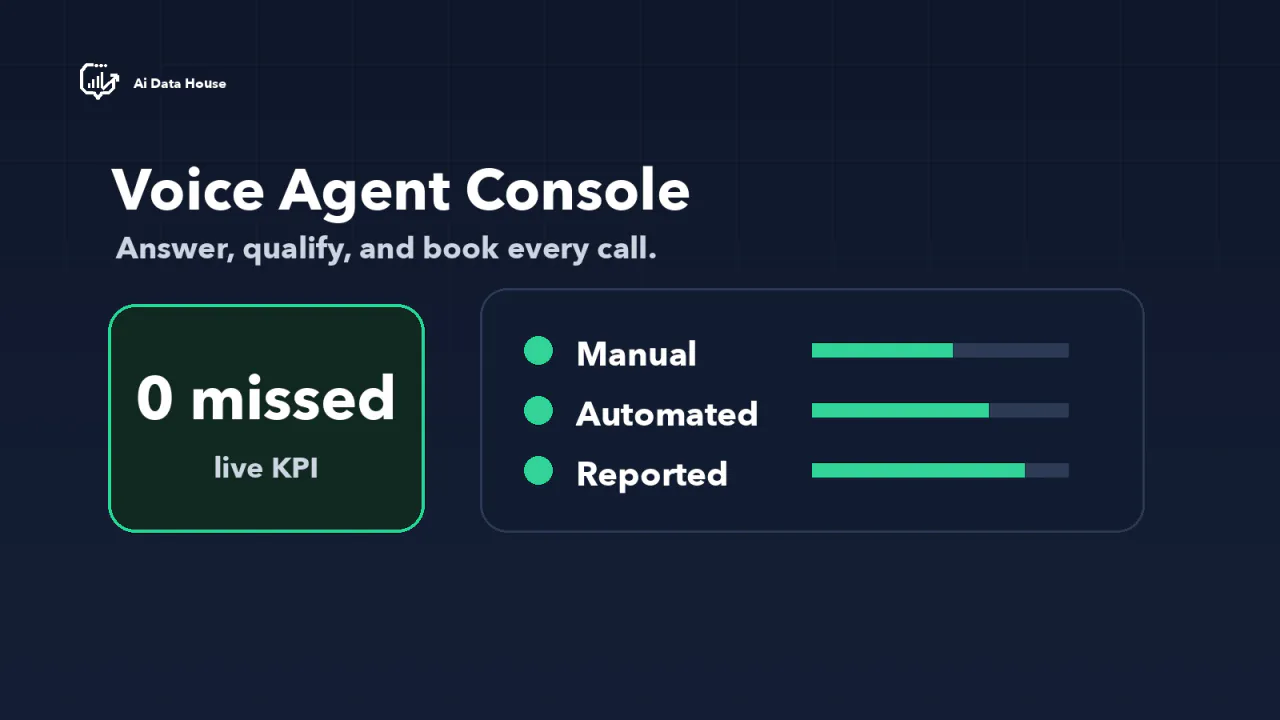
- Your business gets inbound calls (and misses them)
- Your customers prefer to speak rather than type (trades, healthcare, real estate, restaurants)
- Speed of response matters, calls are synchronous and expect an immediate answer
- Your after-hours volume is significant and goes to voicemail
- You are in an industry where phone trust is higher than digital trust (legal, medical, financial)
Best industries for voice agents: restaurants, HVAC, plumbing, medical practices, dental offices, real estate, law firms.
Not sure which one your business needs?
30 minutes. We'll look at your inbound channels and tell you which one gives you the fastest ROI.
The Scenario That Changes Most People's Minds
A typical HVAC company gets 30-40 inbound calls per week. 12 happen outside business hours. 8 of those 12 go to voicemail. 5 of those are not called back until the next morning. 3 of those 5 callers have already booked with a competitor by then. Average job value: $700. 3 jobs lost per week × 52 = 156 jobs/year = $109,200/year in missed revenue.
A voice agent that answers after-hours calls, qualifies the need, and books the appointment runs on a monthly VAPI cost around $30-$60. A chatbot on the same website, meanwhile, might capture 2-3 additional leads per week, valuable, but a completely different scale of impact.
Can You Have Both?
Yes, and eventually most businesses should. The framework: start with whichever channel your customers use most to reach you today. Fix that channel first. Add the second in Phase 2. If your customers mostly call you, voice agent first. If they mostly fill out forms or message you, chatbot first.
The Cost and Timeline Comparison
| Chatbot | Voice Agent | |
|---|---|---|
| Timeline | 14-21 days | 7-21 days |
| Monthly ops cost | $20 to $80 (platform) | $30 to $100 (VAPI + phone) |
| Best for | Text-first journeys | Phone-first / after-hours |
| Hardest part | Knowledge base quality | Voice script + edge cases |
The One Question That Decides It
If a customer needs you right now and you don't pick up, what do they do? If they leave a voicemail and wait: voice agent. If they go to your website and fill out a form: chatbot. If they do both: build both.
Both options are live on our website.
Our AI Voice Agent demo is on the AI Voice Agents page, hear a real AI receptionist handle a restaurant call. Our AI chatbot is live right now in the bottom corner of this page.
The chatbot vs voice agent question is really a question about your customers and how they reach you. Look at your missed calls, your form submissions, your Instagram DMs. Whichever channel is most active and most broken, that is where automation gives you the fastest return. One conversation. One channel. Start there.
Part of a bigger guide