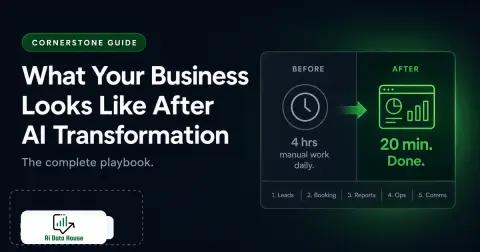
Here is what we find on almost every AI audit call. The business is growing. Revenue is up. The team is working hard. And somehow, things feel more chaotic than they did when the company was smaller.
The reason is almost always the same: the manual processes that worked at $500K/year are not working at $2M/year. The team added volume without adding automation, so they added people instead. And those people are doing things that should not require a person. Here are the six most common ones.
1. Manual lead entry into the CRM
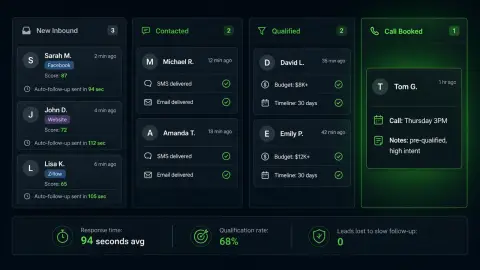
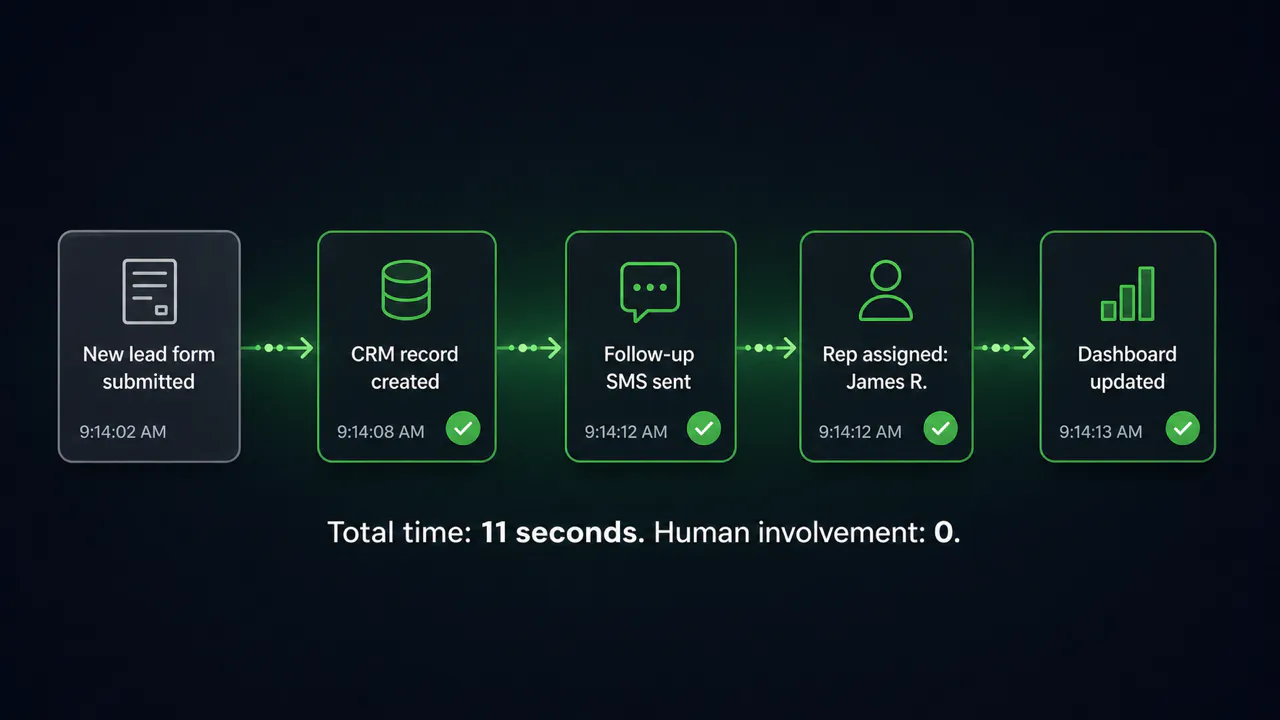
What is happening: someone is reading an email and typing a contact record by hand. The cost: 8 minutes per lead × 50 leads a week = 6.5 hours a week, every week. What automation looks like: form submitted → CRM record created → lead assigned → first contact sent, in 90 seconds. What to build: a webhook from your form or ad platform → automation tool → CRM API.
2. Scheduling back-and-forth
What is happening: 4-7 emails to agree on a meeting time, multiplied by every prospect, every client, every week. The cost: 15 minutes of context-switching per scheduling thread. What automation looks like: the prospect gets a calendar link in their first message, picks a slot, confirmation fires instantly, reminders fire 24h and 1h before. What to build: Calendly or Cal.com wired into your outreach and chatbot flows.
3. Manual reporting
What is happening: someone opens 4 tabs, exports 4 CSVs, pastes them together, reformats the numbers, and sends an email. The cost: 2-4 hours per report. One agency we audited was spending 12 hours every Friday on reports for 18 clients. What automation looks like: all data sources pull automatically on a schedule → dashboard refreshes → the report emails itself. What to build: Looker Studio or Power BI connected to your sources, delivery automated.
4. Internal status updates and handoffs
"Can you tell Sarah that the Jones proposal is approved?" Those Slack messages are really human automation. The average knowledge worker loses 28% of their day to interruptions, and status updates are the number one cause. What automation looks like: CRM status changes from "Proposal Sent" to "Approved" → Slack notification fires to Sarah → task created in her queue. What to build: CRM webhook → n8n or Make.com → Slack and task tool.
5. Follow-up sequences
A lead comes in, someone responds, the lead goes quiet, nobody follows up, because there is no system, just memory and good intentions. Industry data says 80% of sales happen between the 5th and 12th contact. Most businesses stop after the 2nd. What automation looks like: lead goes quiet → day 3 follow-up fires → day 7 → day 14, conditional on whether they responded. What to build: CRM + automation tool → conditional email/SMS sequence.
Recognize your business in this list?
You are not behind. You are exactly where most businesses are when they come to us. We'll identify which of these six is costing you the most and tell you what to build first.
6. Document generation and delivery
Proposals, contracts, invoices, reports, someone opens a template, fills in the fields, saves as PDF, attaches it to an email. The cost: 20-45 minutes per document. What automation looks like: deal status changes to "Closed" → contract auto-populated with client name, scope, and price → PDF generated → sent for signature. What to build: CRM data → document template (Google Docs API or a PDF tool) → e-signature tool → automated delivery.
Which One to Automate First
Not all six are equal. Ask three questions: How many times does this happen per week? How many minutes does it take each time? What is the cost if it fails or gets delayed? The one with the highest answer across all three is your Phase 1. For most businesses that is lead entry + first follow-up: highest frequency, most time-consuming, and the most direct revenue impact when it fails.
The One Rule That Governs All of This
Automate the tasks where the decision is already made. If a human has to think to do it, do not automate it yet. If a human is just executing a rule, "if this, then that", that belongs to automation, not to a person.
The businesses that grow without adding chaos are the ones that automate the execution layer and keep the humans for the judgment layer. Start with one of the six. Build it properly. Watch what the team does with the time they get back. Then come back for the next one.
Part of a bigger guide