In the last 4 years, business owners have come to us with different problems, too many missed calls, reports that take half the day, leads that go cold while sitting in an inbox, operations that only work because one specific person knows where everything lives.
But the story after transformation always follows the same pattern. The owner stops spending Sunday nights catching up. The operations manager stops being the system. The team stops being human duct tape between disconnected tools.
This post is that story. Not our story, yours. What your business looks like 90 days after AI transformation starts. What changed, what didn't, and the order we recommend building it in.
First, What "AI Transformation" Actually Means for a Growing Business
It is not replacing your team with robots. It is not a 12-month ERP implementation. What it actually is: removing the human from every task where the decision is already made.
There are three categories of work that transform. Repetitive decisions that follow a rule. Disconnected data that someone moves by hand between tools. And responses that need to happen faster than a human can deliver them. The 80/20 of it: 80% of the value comes from fixing 20% of the workflows.
What Your Monday Morning Looks Like Before Transformation
Picture an HVAC company owner at 7am. He checks three email inboxes for leads that came in over the weekend. He opens a spreadsheet to manually assign jobs to techs. He forwards a client question to someone who is already in the field. He runs the same report he ran last Monday.
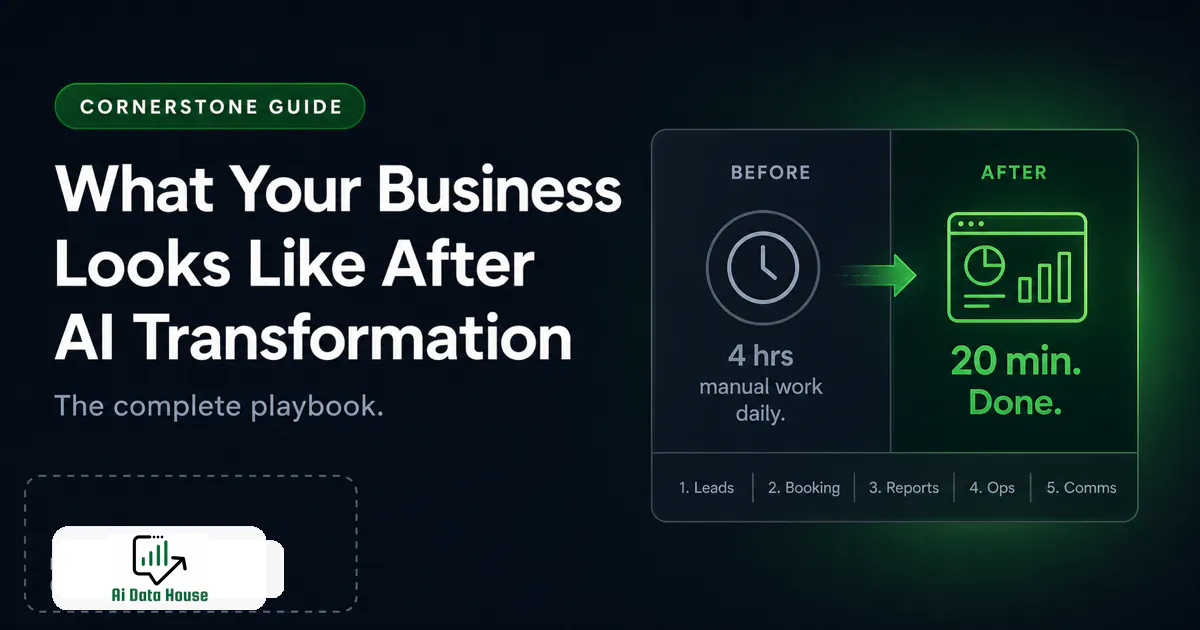
The number: 2.5 hours before any productive work happens. Every Monday. That is the cost of running operations on memory and manual steps.
What Your Monday Morning Looks Like After Transformation
Same owner, 7am, 90 days later. He opens a single dashboard: jobs assigned, leads routed, reports already sent. He answers two emails, the ones that actually needed a human. He is in a strategy meeting by 9am.
The number: 20 minutes to be fully informed and oriented. Here is the part most people miss, none of the decisions were different. Just who was executing them.
Sound familiar?
If your Monday morning sounds more like the before than the after, we should talk. 30 minutes. We map your biggest bottleneck and tell you what to automate first.
The 5 Things We Automate First (And Why This Order Matters)
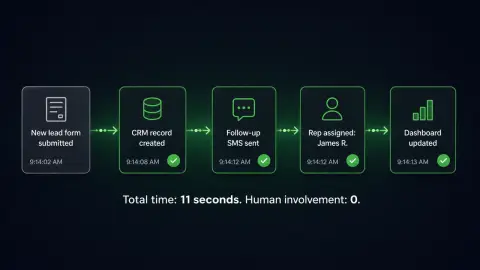
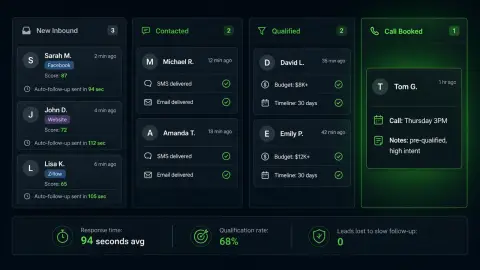
1. Lead capture and first contact. Why first: highest ROI, fastest to build, immediately visible results. New lead → CRM entry → first contact, in under 90 seconds, 24/7. It replaces manual CRM entry, manual follow-up, and the lag between inquiry and response.
2. Appointment booking and confirmations. Why second: directly connected to revenue and removes scheduling back-and-forth. Prospect clicks a link, picks a slot, confirmation fires, reminder fires, rep sees it in their calendar. It replaces email threads to schedule, manual reminders, and no-shows.
3. Reporting and business visibility. Why third: once you can see what is happening, you stop guessing. Daily summary auto-sent, weekly dashboard refreshed, monthly review already built. It replaces manual data pulls and the "I think it's around..." answers.
4. Internal operations, job assignment, status updates, handoffs. Why fourth: this is where team efficiency lives. Trigger-based handoffs, automatic status updates, no one has to remember to tell someone. It replaces the human relay: "hey, did you tell Sarah about the Jones account?"
5. Client communication. Why fifth: you cannot automate the relationship until you have automated the operations behind it. Automatic updates at each stage, smart escalation when something needs a human. It replaces "just checking in" emails and clients chasing updates.
How Long It Takes
| Phase | What Gets Built | Timeline |
|---|---|---|
| Phase 1: Lead + Response | Lead capture, CRM entry, follow-up sequence | 1-2 weeks |
| Phase 2: Booking + Calendar | AI assistant or calendar flow, confirmations, reminders | 1-2 weeks |
| Phase 3: Reporting + Visibility | Dashboard, automated reports, morning briefing | 2-3 weeks |
| Phase 4: Operations | Job routing, handoffs, status automations | 2-4 weeks |
| Phase 5: Client Comms | Update sequences, smart escalations | 1-2 weeks |
Phases 1 to 5 run over 2-3 months. Your price comes from your own build, on the audit. Annual value recovered for most businesses: $40,000-$120,000 in labor, leads, and errors. Payback: almost always under 8 weeks.
The Things AI Transformation Does NOT Change
- Your expertise and judgment still matter
- Relationships are still built by humans
- The creative and strategic work is still yours
- What transforms is the execution layer underneath those things
The Most Common Mistake Businesses Make
- Automating the wrong thing first, the flashy thing, not the highest-value thing
- Building without a clear definition of "done" so the workflow keeps growing
- Automating a broken process, garbage in, garbage out; fix the process first
- Trying to build everything at once, which leads to overwhelm and abandonment
Where to Start If You Are Reading This On Your Own
Run the self-audit: list every task your team does that follows a rule ("if X, then Y"). Rank by hours spent × how often it happens × how much it costs if it goes wrong. Your top 3 are your Phase 1. If you want a shortcut, we do this exact mapping in a 30-minute audit call.
AI transformation is not a technology decision. It is an operations decision. The businesses that do it well are the ones that are honest about where their team's time is going and ruthless about reclaiming it. Not because people aren't valuable, because they are. You did not hire smart people to copy data between spreadsheets.
The transformation starts with one workflow. The one that takes the most time, follows the clearest rules, and would still get done exactly the same way 1,000 times in a row. That is the one we build first.